

This paper explores the landscape of socially responsible investing for philanthropic organizations, particularly endowments and foundations. It aims to address the confusion and concerns among trustees by discussing the spectrum of responsible investment approaches. The paper emphasizes the importance of aligning investment strategies with the organization’s mission and financial goals. It distinguishes between ESG-compliant funds and impact investing, emphasizing the primary purpose of ESG as a framework for evaluating a company’s ability to manage risks and opportunities. Furthermore, it highlights the crucial point that while impact funds are ESG-compliant, not all ESG funds may create measurable impact.
The focus of philanthropic organizations, primarily endowments and foundations, is their commitment to supporting a social cause. The history of their service and dedication to their cause attracts donors and volunteers who share similar values. As an extension of their commitment, many endowments and foundations are interested in aligning their investment portfolios with their social mission and values. However, trustees often find the landscape of responsible investing confusing due to the multitude of terms such as Environment, Social and Governance (ESG), Socially Responsible Investing (SRI), Impact Investing, Mission-Related Investing, and Sustainability. Despite the increasing trend towards responsible investing, there is still a lack of standardization and clarity around the various approaches and measures. According to the 2023 Endowment study by the National Association of Colleges and University Business Officers (NACUBO), members of investment committees have expressed the following concerns:
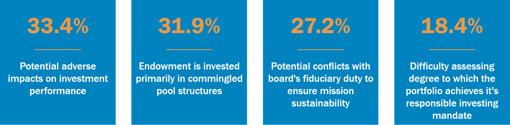
Trustees are feeling inundated by the promotion and political pushback surrounding many of these strategies. Most importantly, many trustees are worried that pursuing any initiatives in this area may jeopardize their financial goal of ensuring the endowment’s consumption rate can be sustained. This, in turn, could lead them to breach their fiduciary responsibilities as stewards of long-term capital. For an organization seeking to delve into the realm of responsible investing, it is crucial to grasp the full scope of its implications and the expectations tied to achieving both financial and social objectives.
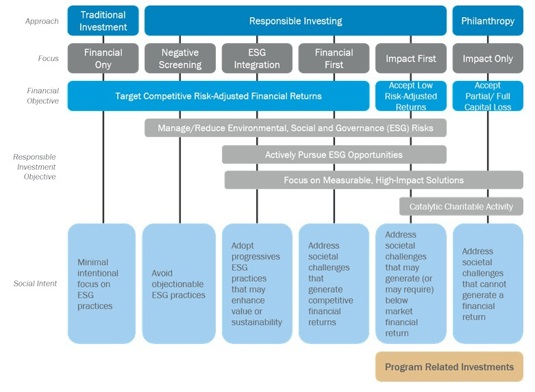
The graph above illustrates the spectrum of social investing approaches, categorized based on the driving intention behind the investor’s decision to engage in responsible investing. As one progresses from the traditional investment approach to philanthropy, there is an increasing level of social engagement. However, many approaches along the spectrum are geared towards generating risk-adjusted financial returns while also endorsing a purposeful social investment approach.
The term "ESG" represents "environmental, social, and governance," which are the broad categories used to assess for-profit corporations in the investment decision-making process. Environmental criteria may involve evaluating a company's overall carbon footprint and its efforts to address waste or pollution. Social criteria could encompass the corporation's labor practices, contributions to charity, and community engagement. Governance criteria might consider board diversity, salary disparities, and transparency.
In a broader sense, elements of E, S, and G criteria are naturally integrated into a more comprehensive assessment of a company's financial and business risk. Even without explicitly adopting a responsible investing approach, a financial analyst would likely undervalue a business with poor product ratings or a history of safety issues. Such companies tend to incur higher customer service costs and have limited growth and profitability potential.
In a responsible investing approach, the investor purposefully emphasizes exposure to one or more E, S, and G factors for evaluation and security selection. This approach seeks to assess both social and financial considerations.
ESG criteria can serve as a means of risk mitigation or an opportunity for responsible investing. Employing a "negative screening" approach using ESG aims to exclude or filter out certain investments so as to better align a strategy with a socially responsible investing mandate. The primary aim of this screening is to mitigate the risk of non-alignment by excluding businesses, companies, entire economic sectors, or countries that do not adhere to pre-established standards. Specific faith-based screens apply this systematic approach to divest their portfolios from businesses whose products or services do not align with their religious doctrine. For instance, Shariah screens strictly exclude businesses, such as banks or credit unions, involved in interest-based financial services. When an objectionable practice is part of a broader business, a "materiality" threshold linked to revenue, or profits generated from that segment guides the screening process. Investors following this approach typically prioritize social alignment and are willing to accept the risk of positive and negative variability in financial performance relative to market returns.
On the other hand, an "ESG Integration" mandate aligns with social values by capitalizing on the opportunity to invest in companies that demonstrate higher standards of business practices in specific E, S, or G factors compared to their peers. If current ESG measures indicate forward-looking outcomes for a company, this mandate can filter companies with sustainable financial advantages resulting from superior business practices in the face of long-term issues like climate change, stricter regulatory demands, and a customer base increasingly attuned to social issues. However, such ESG Integration strategies may require a longer time horizon to realize the potential for improved financial performance compared to peers. Nevertheless, the philanthropic institutions' long-term perspective often compels them to adopt a more forward-thinking approach.
For investors seeking to actively "engage" with their cause, investing in public companies allows them to leverage their ownership stake to advocate for their social values. While financial returns may be the primary focus for an investor, the growing pace of shareholder activism and the emergence of socially guided proxy voting approaches indicate that public equity investors are keen on influencing the companies they own. Investors with the intention to engage may also stipulate that their managers vote "responsibly" in line with the investor’s specific social mandate.
The term ESG primarily serves as a framework for evaluating how an organization functions as a steward in managing the risks and opportunities associated with environmental, social, and governance factors. Coined in 2004 as part of the UN Environment Programme (UNEP) Initiative, a collaborative effort led by the United Nations, the International Finance Corporation, and the Swiss Government, the term promotes the financial industry's consideration of E, S, and G issues in mainstream investment decision-making.
Given that ESG measures rely on publicly reported data, most ESG-focused investments are typically directed toward public equity and fixed-income markets. In essence, any public company can receive a positive or negative ESG rating if the relevant data is available. When reported over time, these measures become fundamental indicators for assessing the success of a responsible investing mandate. While the quality of the data has improved over time, there is still substantial variability in its collection and application.
Significant strides have been made in standardizing the reporting of environmental metrics such as carbon emissions and fuel consumption. However, measures related to social and governance issues remain areas of ongoing development. Diversity data, including gender and ethnicity, is often inconsistently available and reliant on self-reporting, leading to varied interpretations of the data's application. While reported data serves as a scorecard of past activities, some measures can also provide valuable insights for future business decisions. “ESG Integration” approaches seek to leverage these assessments to select firms with more superior forward-looking opportunities.
Companies operating in jurisdictions with rigorous reporting standards naturally gain an advantage when assessed on these measures. However, challenges persist in evaluating businesses operating in certain developing nations with less stringent reporting standards. This issue extends to assessing ESG measures within the global supply chain of businesses located in developing countries.
This is a crucial consideration for trustees who are obligated by their fiduciary duty. It's important to note that in most cases, the social benefits of an investment are measured after the investment takes place. Due to the retrospective nature of ESG measures, the main value for ESG-focused investors primarily lies in financial returns.
Given that ESG mandates are mainly found in public market investment strategies, the financial and social returns of an ESG strategy are often managed and assessed in relation to benchmarks tied to public markets. Since market dynamics vary across different capitalizations and geographies, investors can plan their investment approach to strike a balance between their social and financial objectives.
In markets with a high level of efficiency, like the U.S. equity market, an investor can adopt an ESG approach within a passive investment mandate and customize the level of social restrictions to manage the degree of variability in the index return. If an ESG mandate necessitates the exclusion of companies or entire industries with a substantial weighting in the index, the variance in financial performance, especially over shorter periods, can be significant, either positively or negatively, based on the performance of those holdings or industries. For instance, excluding energy companies from equity portfolios had been beneficial for several years during a period of poor performance for the sector, until 2022, when energy stocks experienced a rally, causing strategies that had chosen to exclude energy names to significantly lag the returns of an unfiltered benchmark.
Adhering to an ESG mandate is akin to employing an actively managed strategy where the investor accepts the "risk" of not achieving market benchmark-like returns in exchange for a more actively screened portfolio. In markets where there's a higher potential for active management to outperform benchmarks, there can be a greater opportunity to apply social screens to identify nonfinancial attributes that enhance a company’s business practices, such as resource efficiency, workplace diversity, or strong corporate governance. The aim would be to select well-managed businesses and provide capital that can have a "real and measurable impact” on the business.
Distinguishing between impact funds and ESG compliant funds is crucial for socially minded investors. Impact investing is characterized by its intentionality and aims to generate a targeted social or environmental benefit. Coined in 2007 at a Rockefeller Foundation conference, the term refers to private investments that yield both financial returns and a social or environmental impact.
While impact investing is not exclusive to private companies, most opportunities historically arise in the private markets, where sophisticated and patient capital is often required to address significant global challenges.
An ESG mandate with an environmental screen may restrict investment in companies producing substantial greenhouse gas emissions. On the other hand, a climate impact fund might invest in existing companies or emerging research actively contributing to emission reduction. The investor in the impact fund takes on the risk associated with investing in a nascent industry, or a sector going through structural changes and will experience the dispersion of returns expected from private equity type investments.
The prospective nature of intent towards impact in private impact investment strategies allows for a more targeted approach to the intended impact. Managers of impact strategies are deeply involved in the underlying business and actively measure the social "value add" in line with their intent, often employing ESG metrics or bespoke elements based on the targeted impact.
Undoubtedly, the future of business and finance integrates social and environmental considerations. When investors pursue impact-oriented private investment strategies, the goal is for the manager to prioritize social or environmental benefits while also having the potential for a financial return. Over longer periods, there is a symbiotic relationship between the social benefits and financial performance, where impact investing proves to be the driver of financial return.
At the same time, Foundations are at the forefront of promoting social good, guided by their mission to address critical social issues within their communities. Many large foundations, such as the Rockefeller Foundation, MacArthur Foundation, and Ford Foundation, extend beyond their grant-making to provide loans and equity investments specifically to small organizations neglected by mainstream financial institutions, particularly if these organizations can advance the welfare of an underserved constituency within the community. For example, program-related investments (“PRI”) in the form of loans to small developers of affordable housing act as a catalyst to attract more lenders from the community to the developer and making it possible for them to build housing for low-income families. Over time, the developer gains financial viability and can return the loan to the Foundation with a small amount of interest.
A Program Related Investment (PRI) represents capital in an investment that falls between the investment portfolio and grant-making, prioritizing social impact over financial return. If it meets the specified qualifications set forth under the IRS tax code, it can count towards grant capital each year. Regarding the financial objective of program-related investments, the return on capital is less important than the return of capital. The Foundation benefits by having the ability, when the capital is returned, to recycle the capital into the community in addition to their normal grant-making. Over time, a steadily built-out laddered portfolio of PRIs adds incrementally to the amount of charitable capital the Foundation can deploy each year towards its social mission.
Fiduciaries looking to pursue responsible investing may consider incorporating their responsible investment objectives into their Investment Policy Statement, covering the following aspects:
For organizations inclined towards responsible investing, it doesn't have to be a daunting task for investment committees. However, it's crucial to clarify the intention to ensure that the selected approach is appropriate and that the measures help assess whether the results are furthering the mission.
The review period of the investment policy statement may serve as an opportune time to evaluate whether integrating responsible investing aligns with the endowment's strategic role.
About Canterbury
Canterbury Consulting is an independent investment advisory firm based in Newport Beach, CA, overseeing $58.1 billion in assets as of June 30, 2025. Canterbury provides consulting services to tax-exempt organizations, including community foundations, educational endowments, religious organizations, arts and cultural foundations, and health care organizations, as well as family offices. Founded in 1988, the firm designs and manages custom investment programs aligned with each client's goals. Canterbury acts as the investment office for its diverse clients and provides objective investment advice, asset allocation, manager selection, risk management, implementation, and performance measurement. Named one of the Best Places to Work in Money Management by Pensions & Investments from 2020 through 2025 as well as one of the Best Places to Work in Orange County by the Orange County Business Journal in 2020 through 2025. Canterbury Consulting strives to deliver performance and service that exceeds the needs and expectations of its clients
Ms. Parekh is a shareholder of Canterbury and is an investment consultant advising clients on investment strategy, risk management and portfolio construction. She is a member of the Canterbury Outsourced CIO platform, which caters to institutions and private clients who wish to outsource day-to-day management of their portfolios to Canterbury. She is also a member of each of the firm’s five Manager Research Committees. She joined Canterbury in 1996 as the manager of analytics with responsibility for directing the firm’s account analysts and client services group. In that role, Ms. Parekh secured many of the asset allocation modeling and research software tools we use today. In 2001, she became the director of manager research, responsible for oversight of all manager, fund, and product research; maintenance of Canterbury’s proprietary research database; and chairing the Investment Manager Research Committee. Ms. Parekh graduated from the University of Hong Kong with a Bachelor of Arts in economics. She completed her Master of Business Administration at Shenandoah University.
Disclosure
The comments provided herein are a general market overview and do not constitute investment advice, are not predictive of any future market performance, and do not represent an offer to sell, or a solicitation of an offer to buy, any security or to engage the services of Canterbury Consulting. Similarly, this information is not intended to provide specific advice, recommendations, or projected returns. The views presented herein represent good faith views of Canterbury Consulting as of the date of this communication and are subject to change. Though these views may be informed by information from sources that we believe to be reliable, we can make no representation as to the accuracy of such sources or the adequacy and completeness of such information. The paper is proprietary to Canterbury Consulting. Under no circumstance may the paper be, in part or in whole, be shown, copied, or forwarded by any means without the prior written consent of Canterbury Consulting.